Food safety
Cleaning fresh produce: water, sodium hypochlorite and baking soda
A practical guide to washing fruit, vegetables and greens safely, separating microbiological reduction, visible-residue removal, and the limits of surface-residue reduction.
Published June 2026
Fruit, vegetables and greens are pillars of a healthy diet. Their safety depends on choosing them well, removing damaged parts, washing correctly, handling them cleanly, and storing them properly.
Washing at home reduces the risk of contamination, but it doesn’t turn fruit, vegetables and greens into sterile food, nor does it remove every chemical residue. Because of this, the correct method depends on the food, how it will be eaten, and how it’s stored.
In practice, there are two different goals:
- reducing microbiological risk, by removing soil, adhered particles, microorganisms and parasites from the surface;
- reducing surface residue, cutting down on some dust, waxes, environmental contaminants and some pesticide residues present externally.
These goals aren’t identical. Running water is the universal base. Sodium hypochlorite is used mainly for microbiological reduction. Baking soda can be discussed as a complement for some surface pesticide residues, but it shouldn’t be treated as the primary disinfectant.
Running water: the universal step
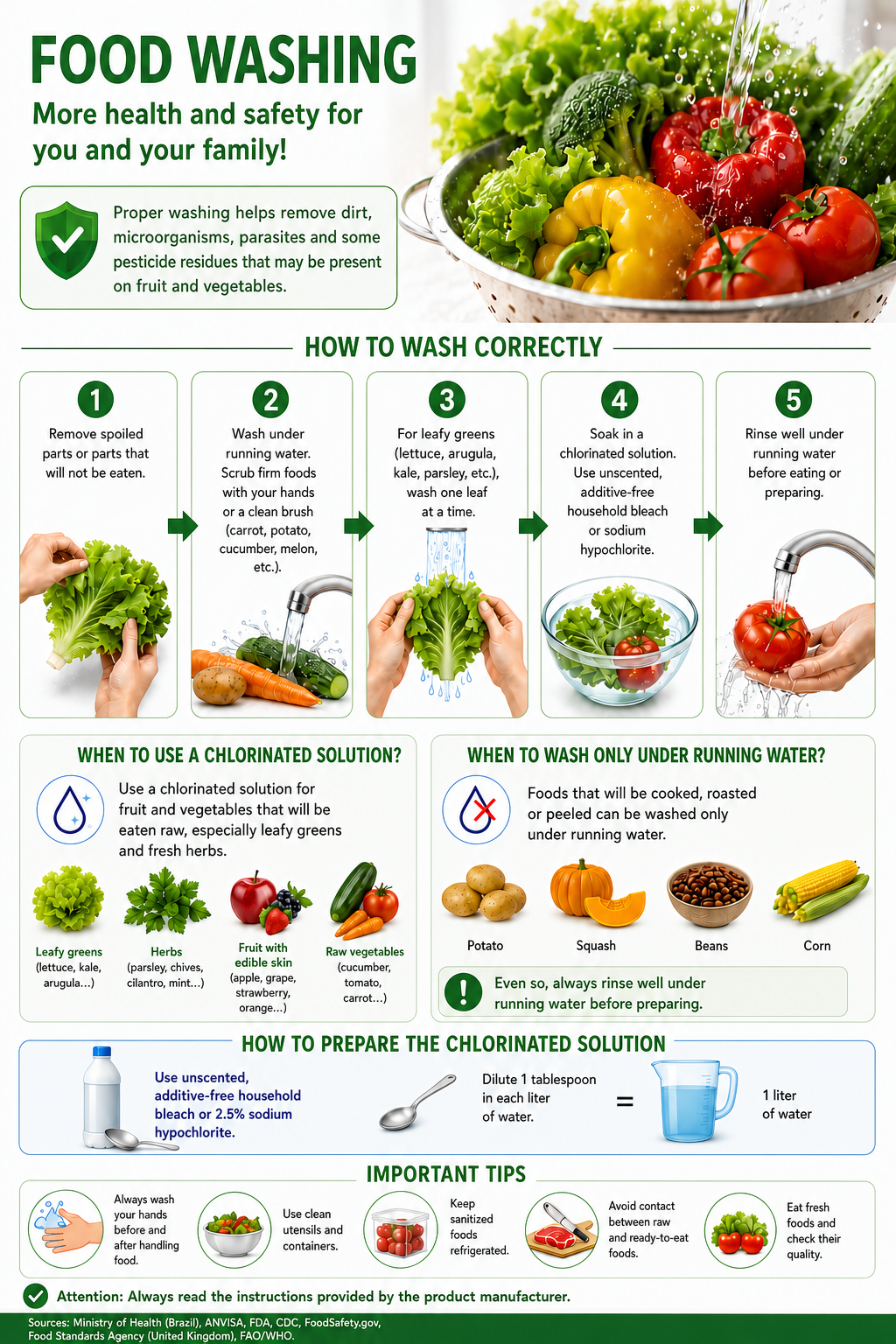
Running water is the first step for fruit, vegetables and greens. It removes soil, adhered particles, some microorganisms and some surface residue. The FDA, CDC, FoodSafety.gov, FSA and Health Canada all agree on this point.
Wash before eating, cutting or cooking. This applies even to foods whose peel won’t be eaten, like melon, watermelon, pineapple, mango and orange. The knife can carry microorganisms from the peel into the flesh during cutting.
For firm produce, use friction:
- melon, watermelon, squash, cucumber and zucchini;
- potato, carrot, beet, cassava, yam and other tubers;
- apple, pear, citrus and thick-skinned fruit.
A clean brush, kept just for food, helps remove soil and visible residue from firm peels. Then dry with clean paper or a clean cloth. Drying reduces residual moisture and improves shelf life.
Some recommended chemical products
In Brazil, the Ministry of Health recommends that fruit, vegetables and greens be washed under running water and then placed in a chlorinated solution when being prepared for consumption. This is an important difference from US and British sources, which prioritize running water and don’t recommend home use of bleach-based sanitizing water or chemical products on produce.
For a Brazilian audience, the safest guidance is to follow the national source and the product label:
2.5% sodium hypochlorite: 1 tablespoon per liter of water, soak for about 15 minutes, then rinse under running water.
Check the label: it needs to be unscented, bleach-free sanitizing water labeled for food use, or a dedicated produce-sanitizing product.
Don’t mix sodium hypochlorite solution with vinegar, lemon, baking soda, detergent, alcohol or any other product. Homemade mixtures can neutralize the products, irritate mucous membranes, and produce unwanted chemical reactions.
Baking soda can be complementary when the goal is to reduce some surface pesticide residue, especially on fruit with an edible peel. It doesn’t replace washing under running water, nor sodium hypochlorite when the goal is microbiological reduction in the Brazilian context.
Soap, detergent, alcohol, disinfectant and generic sanitizer should not be used on produce.
Foods that need more attention
Not all produce carries the same risk. The FAO/WHO highlights groups that need more microbiological attention because of surface area, contact with soil, irrigation water, handling and raw consumption.
Fresh leafy greens and herbs. Lettuce, arugula, watercress, spinach, raw kale, parsley, chives, cilantro, basil and mint have a large contact area and folds that trap soil and adhered particles. When eaten raw, they need leaf-by-leaf washing and, in Brazil, a chlorinated solution at the correct dilution.
Berries and small fruits. Strawberry, raspberry, blueberry and blackberry are delicate, irregular and hard to scrub. Wash them close to the time of eating, handle them as little as possible, dry carefully, and avoid leaving them damp for long before storing.
Melons, watermelons and thick peels. The main risk is transfer from the peel to the flesh during cutting. Wash under running water, scrub with a clean brush, dry, and only then cut.
Roots and tubers. Potato, carrot, beet, cassava and yam carry more soil. They need running water and friction. When eaten raw, extra attention is needed.
Damaged produce. Bruised, moldy, cracked or decaying parts increase risk. Remove small damaged areas when the rest is intact. Discard when there’s widespread mold, altered texture, an odd smell or decay.
Step-by-step by food type
Raw leafy greens, herbs and vegetables.
- Remove spoiled or badly damaged leaves.
- Wash leaf by leaf under running water.
- Prepare the chlorinated solution according to the product’s concentration.
- Soak for about 15 minutes.
- Rinse under running water.
- Dry well before storing or eating.
Firm-skinned fruit and vegetables.
- Wash under running water before cutting.
- Scrub with hands or a clean brush.
- If eating raw with the peel on, consider a chlorinated solution in the Brazilian context.
- Dry before cutting or storing.
Melon, watermelon, squash, pineapple and thick-skinned fruit.
- Wash the peel before cutting.
- Scrub with a clean brush.
- Dry the surface.
- Use a clean knife and cutting board.
- Refrigerate the cut portion.
Berries and delicate fruit.
- Wash close to the time of eating.
- Use gentle running water.
- Avoid intense friction.
- Dry carefully.
- Don’t store them wet for long periods.
Pre-washed, ready-to-eat items.
When the package is sealed, intact and labeled pre-washed or ready-to-eat, the CDC and Health Canada indicate that washing again isn’t necessary. Re-washing can actually increase the risk of recontamination from the sink, counter, colander, hands or cloth.
What not to wash
Not every food should be washed in the kitchen sink. Washing meat, poultry, eggs and seafood can spread microorganisms to the sink, counter, utensils and hands. This spread increases the risk of cross-contamination.
For these foods, safety depends on other measures:
- keeping them separate from ready-to-eat foods;
- cleaning hands, knives, cutting boards and surfaces;
- cooking to a safe temperature;
- refrigerating properly;
- avoiding contact between raw food and salads, fruit and food that’s already ready to eat.
The logic is simple: produce needs mechanical removal and, in Brazil, may require a chlorinated solution when eaten raw. Meat, poultry, eggs and seafood require separation, cooking, and temperature control.
Conclusion
Cleaning fresh produce is a food safety practice, not a pursuit of sterilization. The right routine reduces risk by combining running water, friction, the appropriate product when indicated, rinsing, drying, clean utensils, and proper storage.
For a Brazilian audience, the guidance most aligned with the Ministry of Health is: remove damaged parts, wash under running water, wash leaves one by one, and use a chlorinated solution when indicated, with a dedicated product and the correct dilution.
Baking soda can have a complementary place for some surface pesticide residue, especially on fruit with an edible peel. It doesn’t replace sodium hypochlorite for microbiological reduction, and it doesn’t remove residue that has penetrated the food.
The safest choice is to avoid shortcuts: no soap, detergent, alcohol, vinegar, lemon as a sanitizer, homemade mixtures, or products not intended for food. Food safety is built through a method that’s simple, repeatable, and matched to the type of food.
References
Scientific studies
Ministério da Saúde, 2022.Como escolher, higienizar e armazenar frutas, verduras e legumes. Ministério da Saúde; 2022. · Acessar fonte
Key findings
The central Brazilian source for this article. It recommends choosing intact produce, removing damaged parts, washing fruit, vegetables and greens under running water, washing leaves one by one, and using chlorinated water with unscented, bleach-free sanitizing water or a dedicated sodium-hypochlorite-based product, following the product's concentration.
Ministério da Saúde, DTHA.Doenças de Transmissão Hídrica e Alimentar. Ministério da Saúde. · Acessar fonte
Key findings
Reinforces prevention of water- and food-borne illness, including personal hygiene and proper food handling. The text highlights mechanical scrubbing under running water and disinfecting produce before consumption.
ANVISA, PARA.Programa de Análise de Resíduos de Agrotóxicos em Alimentos. Agência Nacional de Vigilância Sanitária. · Acessar fonte
Key findings
Brazil's official monitoring program for pesticide residues in retail food. It's the national reference for discussing chemical residues, maximum permitted limits, compliance and regulatory oversight.
FDA.Selecting and Serving Produce Safely. U.S. Food and Drug Administration. · Acessar fonte
Key findings
Recommends washing fruit and vegetables under running water before preparing or eating them, including ones that will be peeled. It does not recommend soap, detergent or commercial washing products, because fruit and vegetables are porous and can absorb substances not intended for consumption.
CDC.Fruit and Vegetable Safety. Centers for Disease Control and Prevention. · Acessar fonte
Key findings
Recommends washing or scrubbing fruit and vegetables under running water before eating, cutting or cooking; firm produce can be scrubbed with a clean brush. Products labeled pre-washed or ready-to-eat don't need to be washed again.
FoodSafety.gov.Safe Ways to Handle and Clean Produce. FoodSafety.gov. · Acessar fonte
Key findings
Reinforces cold running water, a clean brush for firm produce, and drying with paper or a clean cloth. It does not recommend soap, bleach, alcohol, disinfectants, sanitizers, vinegar, lemon or other chemical products to remove germs from fruit and vegetables.
Food Standards Agency.Why is cleaning important? Food Standards Agency. · Acessar fonte
Key findings
A British source that emphasizes washing with water, scrubbing the peel, and removing soil before eating. It also reinforces cleaning hands, surfaces and utensils to reduce cross-contamination.
Health Canada.Produce safety. Government of Canada. · Acessar fonte
Key findings
Recommends washing fresh fruit and vegetables under running water, using a clean brush for firm items, and not using a dedicated produce-washing product. Pre-washed, sealed-package greens don't need to be washed again.
FAO/WHO, 2023.Prevention and control of microbiological hazards in fresh fruits and vegetables. FAO/WHO JEMRA; 2023. · Acessar fonte
Key findings
An international assessment of microbiological hazards in fresh fruits and vegetables. It highlights higher-attention groups, such as leafy greens and herbs, berries and small fruits, melons, tree fruits, seeded vegetables and roots.
EFSA.Pesticides. European Food Safety Authority. · Acessar fonte
Key findings
A European reference for the regulatory assessment of pesticides, maximum residue limits and consumer risk. It helps contextualize that chemical residues are controlled mainly through food-chain surveillance and regulation.
Yang et al., 2017.Effectiveness of Commercial and Homemade Washing Agents in Removing Pesticide Residues on and in Apples. Journal of Agricultural and Food Chemistry. 2017;65(44):9744-9752. · Acessar fonte
Key findings
An experimental study on apples showing that a baking soda solution reduced some surface pesticide residues better than tap water and a bleach-type solution. The study also showed that residues that had penetrated the peel were not completely removed.
Informational content. Health recommendations and protocols require individual assessment by qualified professionals.