Exercise and metabolism
Muscle as an endocrine organ: exercise, myokines and where the fat actually goes
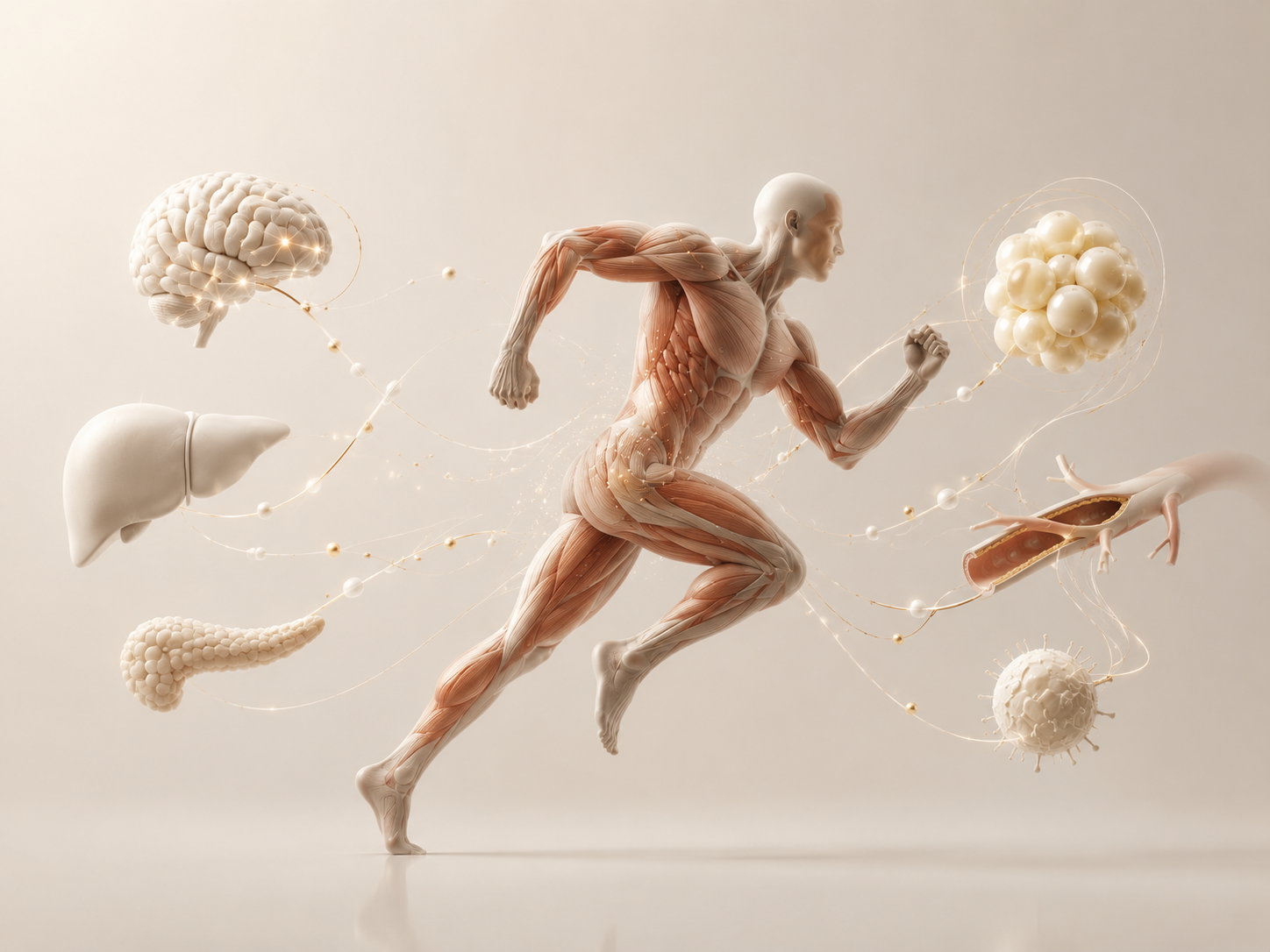
How muscle contraction talks with the brain, liver, adipose tissue, pancreas, blood vessels and immune system, and why the fat lost mainly leaves through breathing.
Exercise burns energy, sends signals, remodels tissue, and changes how the body uses its reserves.
Published June 2026
For decades, muscle was presented as a mechanical tissue: it contracts, moves, holds posture, lets us walk, lift, run. That view turned out to be too small. Today, skeletal muscle is also understood as a communication and signaling organ.
When a muscle fiber contracts, it consumes energy and releases signaling molecules. This set includes myokines and is part of a larger network of exerkines, capable of communicating with the liver, adipose tissue, pancreas, blood vessels, bones, immune system and brain.
This shift in perspective has transformed how medicine understands exercise. Training is now seen as a biological intervention: a way to improve glucose uptake, fat use, mitochondrial function, inflammation, strength, autonomy and metabolic health.
Muscle as an endocrine organ
Endocrine organs release substances that travel through the blood and change the behavior of other tissues. Muscle does this when it contracts.
The molecules released by active muscle are called myokines. In a broader concept, exercise also releases exerkines: signals produced by muscle, heart, liver, adipose tissue, blood vessels, platelets, the nervous system, and the immune system in response to movement. Muscle is a central player in this network, alongside other tissues that also take part in the exercise response.
This communication reaches:
- the brain;
- the liver;
- adipose tissue;
- the pancreas;
- the heart;
- blood vessels;
- the immune system;
- bones.
Because of this, two people can have relevant metabolic changes even before a major shift in weight. Exercise improves the body’s biology through pathways the scale barely measures: insulin sensitivity, mitochondrial function, inflammation, perfusion, strength, autonomy and body composition.
The central idea is simple: active muscle is signaling muscle.
Myokines: the internal pharmacy
Exercise activates a kind of internal pharmacy. In biochemical terms, repeated muscle contractions release signals that change distant organs.
This set includes proteins, peptides, signaling lipids, metabolites, microRNAs, and extracellular vesicles. Within this universe, muscle-derived myokines are the most studied.
Among the most observed myokines and related pathways are IL-6, irisin, IL-15, myostatin, apelin, signals linked to BDNF, and the PGC-1α axis. The distinction matters: PGC-1α is an intracellular regulator, linked to mitochondrial biogenesis and oxidative programming, and appears in this text as an adaptive exercise pathway. The central point is that muscle acts as a living communication tissue.
IL-6. For a long time, IL-6 was read mainly as an inflammatory marker. In exercise, the context is different. The IL-6 released by muscle during contraction works as a transient pulse of energy communication: it rises with the muscle mass recruited and with the duration of effort, helps mobilize substrates, favors fat use, takes part in glucose uptake, and integrates with gut and metabolic signals. In prolonged exercise, its concentration can increase many times over, reaching near 100-fold elevations in specific protocols. Studies in humans also suggest its signaling takes part in the training-induced reduction of visceral fat.
Irisin. Irisin became known for its relationship with the adaptation of white adipose tissue toward a more metabolically active profile, energy expenditure, and exercise-induced responses. It derives from the precursor FNDC5 and connects to the PGC-1α axis, one of the pathways linked to mitochondrial adaptation. It’s an important candidate for the dialogue between muscle and adipose tissue; its quantification and functional magnitude in humans remain active areas of research.
BDNF. BDNF, short for Brain-Derived Neurotrophic Factor, is often called brain fertilizer. Exercise activates pathways linked to neuroplasticity, memory, learning and neuronal protection, with a consistent association with increased BDNF in contexts of cognition, aging, and mental health. The more precise reading is a muscle-brain axis: the direct endocrine contribution of muscle-derived BDNF in humans is less established than that of IL-6, while exercise’s effect on brain BDNF pathways is well documented.
This set helps explain why exercise is richer than a calorie count. Calories matter, and the biological signal also guides the adaptation.
What happens after exercise
During exercise, muscle rapidly increases its demand for ATP, the cell’s immediate energy currency. Depending on intensity, duration, prior nutrition, and conditioning, the body combines different sources in a dynamic sequence:
- stored ATP, in the first seconds;
- phosphocreatine, in very short, intense efforts;
- muscle glycogen, as the session progresses;
- blood glucose;
- fatty acids;
- ketone bodies, in specific contexts.
In the following minutes and hours, trained muscle becomes more receptive to nutrients. Glucose uptake increases, insulin sensitivity improves, and glycogen replenishment becomes more efficient. This effect helps explain why exercise improves insulin resistance even before major changes in weight.
In resistance training, protein synthesis pathways are also activated, including mTOR, muscle remodeling, and the involvement of satellite cells, which support fiber repair and adaptation.
In the following 24 hours, the body can increase GLUT-4, glycogen replenishment, protein synthesis, tissue repair, and signals linked to mitochondrial biogenesis. With repetition, the result is a transformed tissue.
Exercise is training plus recovery. Adaptation happens when the stimulus meets sleep, protein, enough energy, hydration, micronutrients, and time. Because of this, the result comes from the whole picture: movement, nutrition, rest, and consistency.
In resistance training, this logic is very clear. Training creates a mechanical and metabolic signal; recovery turns that signal into stronger fibers, better neuromuscular coordination, and greater functional reserve.
Mitochondria and metabolic flexibility
One of modern physiology’s great discoveries was understanding that repeated exercise increases muscle’s mitochondrial capacity. The PGC-1α axis is one of the most important pathways in this adaptation and helps coordinate the formation of new mitochondria.
Over time, trained muscle tends to:
- increase the number and efficiency of mitochondria;
- improve oxidative capacity;
- use fat and glucose better;
- better tolerate variations in energy availability;
- reduce the buildup of ectopic lipids in contexts of metabolic improvement;
- respond better to insulin.
This metabolic flexibility is central. A metabolically flexible body switches better between carbohydrate and fat as fuel, and copes better with meals, training, periods of lower energy availability, and muscle demand. It’s one of the reasons regular exercise improves the metabolic ground more broadly than the scale can show.
This effect also involves mitochondrial quality. Exercise stimulates renewal, recycling, and efficiency of mitochondria, favoring muscle that’s better able to produce energy at a lower inflammatory cost.
Where the fat goes
When a person loses weight, the fat follows a concrete biochemical path. It’s largely transformed into exhaled air.
Body fat is stored mostly as triglycerides, molecules made of carbon, hydrogen, and oxygen. When the body needs to use this reserve, oxidation occurs. In this reaction, the fat’s atoms rearrange with the oxygen we breathe and form mainly carbon dioxide and water.
Most of the mass of the lost fat leaves through the lungs, as CO2. A smaller part turns into water, eliminated through urine, sweat, feces, tears, and breath vapor.
The classic BMJ article calculated that, when oxidizing 10 kg of body fat, about 8.4 kg leave as CO2 and 1.6 kg leave as water. The phrase “burning fat” is a useful but incomplete metaphor. What happens in the body is biochemistry: controlled oxidation, energy production, and elimination of byproducts.
This data also changes how we read sweat. A sauna, thermal clothing, and intense sweating can temporarily reduce body water; fat loss happens when the body oxidizes triglycerides and eliminates their byproducts. In large part, the fat passes through us and leaves with every exhale.
How exercise helps the fat leave
Exercise creates conditions for the body to use reserves more efficiently.
This happens through several pathways:
- it increases energy expenditure;
- it raises muscle demand for ATP;
- it increases glucose uptake by muscle;
- it improves insulin sensitivity;
- it increases mitochondrial capacity;
- it improves fatty acid oxidation;
- it preserves muscle mass during weight loss;
- it reduces visceral fat when combined with a sustainable strategy.
Aerobic exercise increases oxygen flow and energy demand. Walking, cycling, running, swimming, and training at moderate to vigorous intensity raise substrate oxidation, especially when done consistently.
Resistance training has another decisive role: preserving and building muscle. During weight loss, protecting muscle mass improves function, strength, energy expenditure, and the quality of the loss. Because of this, in metabolic medicine, the central question is: what changed in body composition?
Exercise, weight loss and body composition
The best outcome is reducing risk-related adiposity, preserving lean mass, and improving waist, glucose, blood pressure, lipids, function, and autonomy.
The 2024 JAMA Network Open meta-analysis showed a dose-response relationship between supervised aerobic exercise and reduced weight, waist, and body fat in adults with overweight or obesity. The practical point matters: at least 150 minutes a week of aerobic exercise at moderate intensity or higher was associated with clinically relevant reductions in waist and body fat.
The 2025 BMJ Open Sport & Exercise Medicine review, meanwhile, evaluated resistance training during diet-induced weight loss. Resistance training protected fat-free mass, increased fat loss, and improved strength, reinforcing the value of looking at body composition.
This is the most important clinical point: two people can lose the same weight and have very different biological outcomes. Those who preserve muscle tend to come out of the process with more function, better body composition, and a better chance of maintaining the result.
In practice, exercise changes the quality of the weight loss. The scale shows total mass; body composition shows whether the process preserved muscle, reduced risk-related fat, and improved the body’s ability to use energy.
Modalities, longevity and recovery
Each modality delivers a different type of signal. The best plan usually combines complementary stimuli, adjusted to the person’s clinical moment and conditioning.
| Goal | Practical strategy |
|---|---|
| Cardiometabolic health | Brisk walking, cycling, swimming, or light running, aiming for at least 150 minutes a week when safe |
| Waist and body fat reduction | Progressing to 150 to 300 minutes a week of moderate to vigorous aerobic exercise |
| Muscle preservation | Resistance training 2 to 3 times a week, with progression in load, technique, and recovery |
| Mitochondria and cardiorespiratory capacity | Interval sessions in adapted people, with an individualized dose |
| Functional longevity | Strength, balance, mobility, gait, power, and consistency |
The mechanisms most linked to longevity converge on a few axes:
- improved insulin sensitivity;
- reduced visceral fat;
- increased mitochondrial function;
- improved endothelial function;
- preserved muscle mass;
- protection against frailty and sarcopenia;
- modulation of systemic inflammation;
- support for sleep, mood, cognition, and BDNF.
Age-related muscle loss is one of the major markers of frailty. Regular strength training, even started later in life, helps preserve independence, balance, the ability to stand up, walk, climb stairs, and live with more autonomy.
Obesity as an adiposity-based disease
Recent guidelines have changed the language. Obesity is now understood as a disease based on adiposity, fat distribution, signs of organ dysfunction, and functional impact. The 2025 Lancet Diabetes & Endocrinology Commission reinforces this shift.
NICE, ADA, AACE, Canada, and Brazilian guidelines move in the same direction: treatment needs to take into account cardiometabolic risk, waist, complications, function, quality of life, patient preferences, and sustainability.
Medications like GLP-1 and GIP/GLP-1 agonists can play an important role in selected patients, with significant weight loss documented in recent clinical trials. The more potent and faster the weight loss, the greater the importance of preserving lean mass, strength, protein intake, resistance training, and recovery.
Exercise becomes a partner to pharmacotherapy: it improves function, protects muscle, expands cardiorespiratory capacity, and helps the body sustain the result.
Muscle is part of obesity treatment because it sustains dimensions the scale measures only in a limited way: autonomy, glucose, strength, metabolism, protection against frailty, and quality of life.
Exercise and inflammation
Exercise generates a small amount of acute stress. At an adequate dose, this stimulus triggers adaptive responses: improved antioxidant defense, mitochondrial remodeling, anti-inflammatory signaling, and repair.
This phenomenon is called hormesis: a controlled stimulus, at an adequate dose, produces a positive adaptation.
With regularity, exercise can reduce systemic inflammation, improve endothelial function, modulate visceral adipose tissue, and favor better communication between muscle, liver, fat, and the immune system. The key lies in the dose and the recovery: enough stimulus to adapt, enough rest to consolidate.
Safety and individualization
For most people, the starting point can be simple. Clinical assessment helps choose dose, progression, and modality when there’s greater complexity.
Aerobic movement. Brisk walking, cycling, swimming, light running, or the elliptical help increase energy expenditure, improve cardiorespiratory capacity, and favor substrate oxidation. The initial goal can be to walk more and reduce sedentary time; the clinical goal usually moves toward at least 150 minutes a week, when safe.
Resistance training. Weight training, bodyweight exercises, resistance bands, or machines help preserve muscle mass, strength, and function. During weight loss, especially when it’s happening quickly, this axis becomes central.
Recovery. Sleep, protein, hydration, and regularity determine whether the stimulus turns into adaptation. Resistance training opens the signaling; recovery turns that signaling into stronger tissue.
Individualization. Pain, cardiovascular disease, diabetes, medication use, severe obesity, sarcopenia, menopause, injury history, and conditioning level all change the prescription. This text is educational; the training plan should be adapted to each person’s clinical status and safety.
Some contexts deserve closer professional guidance:
- known cardiovascular disease, arrhythmia, heart failure, chest pain, disproportionate shortness of breath, or fainting with exertion;
- diabetes treated with insulin or secretagogues, due to the need to adjust nutrition, glucose, and hypoglycemia risk;
- recent use of GLP-1 or GIP/GLP-1 during a phase of rapid weight loss, with attention to protein, hydration, strength, and body composition;
- advanced kidney disease, significant liver disease, active cancer, recent postoperative period, or post-bariatric surgery;
- sarcopenia, frailty, fall risk, limiting pain, or injury history;
- pregnancy, postpartum recovery, and phases of greater energy vulnerability.
The goal is to turn exercise into a sustainable prescription: enough stimulus, achievable progression, adequate recovery, and follow-up proportional to risk.
Conclusion
Muscle is much more than structure. It’s an endocrine, metabolic, and functional organ. When it contracts, it talks with the whole body.
The fat lost follows a concrete material path: it’s oxidized; most of the mass leaves as CO2 through the lungs and the rest as water. Exercise supports this process because it increases energy demand, improves insulin sensitivity, expands mitochondrial capacity, preserves muscle, and makes the body better able to use its reserves.
Losing weight well means losing fat while preserving muscle, function, and metabolic health.
Exercise is a way of teaching the body to function better. For longevity, the best exercise is the one that preserves muscle, improves cardiorespiratory capacity, respects recovery, and fits into a life for decades to come.
References
Scientific studies
Pedersen & Febbraio, 2012.Muscles, exercise and obesity: skeletal muscle as a secretory organ. Nature Reviews Endocrinology. 2012;8:457-465. · Acessar fonte
Key findings
A classic review that consolidated the concept of skeletal muscle as a secretory organ. It explains how muscle releases myokines, including IL-6, that communicate with adipose tissue, glucose and inflammation. Muscle-derived IL-6 can increase up to 100-fold during prolonged effort, without representing pathological inflammation.
Chow et al., 2022.Exerkines in health, resilience and disease. Nature Reviews Endocrinology. 2022;18:273-289. · Acessar fonte
Key findings
A comprehensive review of exerkines, molecules released in response to exercise by muscle, liver, adipose tissue, blood vessels and the immune system. It shows how proteins, metabolites, extracellular vesicles and microRNAs form a communication network that explains exercise's cardiometabolic, neurological, bone, and immune benefits.
Meerman & Brown, 2014.When somebody loses weight, where does the fat go? BMJ. 2014;349:g7257. · Acessar fonte
Key findings
Using stoichiometry, it shows that oxidizing 10 kg of body fat releases about 8.4 kg as CO2 through the lungs and 1.6 kg as water. Most of the lost fat mass leaves with every exhale, not through sweat, and it doesn't turn into muscle.
Jayedi et al., 2024.Aerobic exercise and weight loss in adults: a systematic review and dose-response meta-analysis. JAMA Network Open. 2024;7(12):e2452185. · Acessar fonte
Key findings
With 116 randomized trials and 6,880 adults with overweight or obesity, it showed a dose-response relationship between aerobic exercise and reduced weight, waist and body fat. At least 150 minutes a week at moderate intensity or higher was associated with clinically relevant reductions.
Binmahfoz et al., 2025.Effect of resistance exercise on body composition, muscle strength and cardiometabolic health during dietary weight loss in people living with overweight or obesity: a systematic review and meta-analysis. BMJ Open Sport & Exercise Medicine. 2025;11:e002363. · Acessar fonte
Key findings
A meta-analysis of 35 clinical trials on resistance training during diet-induced weight loss. Resistance training protected against fat-free mass loss, increased fat loss, and improved muscle strength, meaning it changes what's lost, not just how much.
Informational content. Health recommendations and protocols require individual assessment by qualified professionals.