
Lifestyle and biology
Meditation: the practice that reprograms stress, inflammation and metabolism
A mind-body practice with measurable effects on the stress axis, gene expression, inflammation and cardiometabolic outcomes.
Clinical evidence, biological mechanisms, and a step-by-step guide to starting a daily practice.
Meditation strengthens a person's role as protagonist of their own health because it helps them notice, choose and act with more awareness.
Published May 2026
Meditation is a structured, accessible, low-cost mind-body practice aimed at training attention, presence, and emotional self-regulation.
Its main formats, mindfulness, breath-focused meditation, mantra repetition, and contemplative practices, train the person to observe thoughts, sensations, and emotions with more clarity, reducing automatic reactivity to stress and favoring a more conscious internal response.
From a scientific standpoint, meditation’s effects are observed across psychological, neuroendocrine, inflammatory, and cardiovascular dimensions. Systematic reviews and meta-analyses show that structured meditation programs help reduce anxiety, depressive symptoms, perceived stress, and pain in adults, supporting its use as a relevant complementary strategy for health promotion.
The practice acts on the stress response, involving the hypothalamic-pituitary-adrenal (HPA) axis, the sympathetic nervous system, and inflammatory pathways connecting the brain, immunity, metabolism, and the cardiovascular system. People living in a state of continuous vigilance, overload, hyper-responsibility, poor sleep, hyper-stimulation, tend to keep these systems chronically activated, with effects associated with visceral adiposity, insulin resistance, dyslipidemia, and hypertension.
The American Heart Association (AHA) recognizes meditation as a promising complementary intervention for reducing cardiovascular risk, with documented effects on stress, anxiety, depression, sleep quality, and blood pressure. Meta-analyses with more than 11,000 participants document improvements in anxiety, depression, distress, and well-being; the review in JAMA Internal Medicine documents additional benefits for chronic pain.
Clinical evidence on stress, inflammation and metabolism
The researchers (2014, JAMA Internal Medicine), with 47 randomized clinical trials and 3,515 participants, showed that mindfulness programs have a moderate-magnitude effect on anxiety (effect 0.38), depression (0.30), and chronic pain (0.33). For sleep, attention, eating habits, weight, and substance use, the evidence was insufficient. The clinical takeaway is that meditation adds to active treatments like medication, physical exercise, and other behavioral therapies within an integrated, personalized, sustainable plan.
The most comprehensive meta-analysis to date, published in PLOS Medicine in 2021, brought together 136 clinical trials and 11,605 participants in 29 countries. Compared with no intervention, mindfulness reduced:
- Anxiety - standardized mean difference -0.56 (moderate effect)
- Depression - SMD -0.53 (moderate effect)
- Psychological distress - SMD -0.45
- Subjective well-being - SMD +0.33 (increase)
The authors transparently emphasize that heterogeneity between studies is high and that mindfulness wasn’t superior to other active practices, physical exercise, for example, produces a similar benefit. The choice can be personalized according to affinity.
In populations with elevated cortisol, the meta-analysis by the researchers (2021, Health Psychology Review) brings a clinically precise data point: meditation reduced blood cortisol with a medium effect (g=0.62) in patients with somatic disease (cancer, cardiovascular disease, type 2 diabetes, polycystic ovary syndrome) or in chronic stress situations (caregivers, low socioeconomic status, smoking cessation). In healthy people without marked stress, the effect was small, meditation buffers stress more for those who need it most. An additional practical finding: programs with more than 20 total hours were significantly more effective, and the benefit is sustained over time.
The AHA’s 2021 statement brings concrete numbers on the clinical weight of psychological stress:
- High perceived stress is associated with a 27% higher risk of coronary heart disease and cardiovascular death.
- Depression increases the risk of heart attack by 30% and stroke by 45%.
- Social isolation and loneliness increase the risk of cardiovascular events by 50%.
Stress, depression, anxiety, and isolation are active modifiers of cardiovascular risk, not passive consequences of disease. Interventions to improve psychological health have a demonstrated impact on clinical outcomes.
In parallel, the systematic review by the researchers (2017, Frontiers in Immunology) documents the conserved molecular signature of mind-body practices: reduced expression of pro-inflammatory NF-kB pathway genes and increased expression of anti-inflammatory pathways, the opposite of the pattern induced by chronic stress.
How meditation changes biology
The effects aren’t mysterious. The literature shows three main documented mechanisms.
Modulation of the HPA axis and the autonomic nervous system
Regular practice reduces HPA axis reactivity to stressors and lowers baseline cortisol levels. At the same time, it increases parasympathetic tone, reflected in greater heart rate variability (HRV), a marker of healthy autonomic regulation.
The vagus nerve: the structure behind HRV
The vagus nerve is the main pathway of the peripheral parasympathetic nervous system and operates bidirectionally. Approximately 80% of its fibers are afferent, carrying signals from the organs (heart, lungs, gut) back to the brainstem, continuously informing the brain about the body’s state. It’s this structure that HRV indexes: every variation in heart rhythm reflects the vagal tone of the moment.
Slow, controlled breathing, at approximately 6 cycles per minute, is the most direct, immediate route to vagal tone. During inhalation, vagal influence momentarily recedes and heart rate rises; during exhalation, the vagal brake re-engages and the heart slows. This phenomenon, respiratory sinus arrhythmia (RSA), maximizes HRV oscillations and optimizes the baroreflex (Lopez Blanco & Tyler, 2025). The researchers (2022, Neuroscience & Biobehavioral Reviews), with 223 studies, confirmed that voluntary slow breathing consistently increases vagally mediated HRV during the session, immediately after, and across multi-session interventions. A second meta-analysis with 31 studies and 1,133 participants documented reduced systolic pressure and increased RMSSD and SDNN with a moderate effect.
With weeks of regular practice, the gains consolidate into resting vagal tone, lower baseline heart rate, a more sensitive baroreflex, and greater autonomic resilience (Lopez Blanco & Tyler, 2025). The vagus nerve also connects breathing and inflammation: afferent fibers detect peripheral inflammatory signals and, through the efferent branch, activate the cholinergic anti-inflammatory pathway, suppressing pro-inflammatory cytokine production by macrophages. Tracey (2002, Nature) described this mechanism as the inflammatory reflex, the neural basis through which the nervous system regulates the immune response in real time.
Changes in gene expression and inflammatory profile
This may be the most elegant part. The systematic review by the researchers (2017, Frontiers in Immunology), with 18 studies on mind-body practices (meditation, yoga, tai chi, qigong, conscious breathing, the relaxation response), identified a conserved molecular signature: reduced expression of pro-inflammatory NF-kB pathway genes (RIPK2, COX2, IL-6) and increased anti-inflammatory pathways.
This pattern is the opposite of what chronic stress produces. Sustained stress activates a transcriptional program known as CTRA, conserved transcriptional response to adversity. CTRA is a molecular pattern found in people exposed to grief, a cancer diagnosis, trauma, low socioeconomic status, and cumulative stress, and it increases expression of pro-inflammatory genes while reducing antiviral defense. Meditation reverses this program.
This is an important takeaway: lifestyle modifies gene expression without changing the DNA sequence. This is applied epigenetics, behavior and environment change how biology functions, as reinforced by the official material from the Centers for Disease Control and Prevention (CDC) on the topic.
Integrated cardiometabolic impact
The reduction in cortisol and inflammation has a metabolic ripple effect. Elevated cortisol promotes gluconeogenesis, insulin resistance, and visceral fat accumulation. Low-grade systemic inflammation is a central mediator of insulin resistance and atherosclerosis progression. Attenuating these two axes, even modestly, affects the ground on which metabolic syndrome and cardiovascular disease take hold.
Step-by-step: how to start a daily practice
Before the technique, three common myths that get in the way of starting, debunked by Mayo Clinic’s official material (2026):
- “I need to empty my mind.” You don’t. Mindfulness is about noticing thoughts as they are and letting them pass without holding on to them.
- “I need to sit cross-legged for long periods.” You don’t. The practice can be done sitting, standing, walking, or lying down. It can happen during an everyday task, like eating or brushing your teeth.
- “I don’t have time for this.” Even 10 minutes a day produces a documented benefit. Three conscious breaths in a moment of tension already count.
The literature shows that regularity beats duration. Five to ten minutes a day, every day, beats thirty minutes once a week. Three options with well-established evidence:
Diaphragmatic breathing (5 to 10 minutes)
The simplest and best-documented entry point. Slow. Deep. Controlled. It stimulates the parasympathetic system within minutes and reduces heart rate from the very first sequence of breaths.
Exhalation is the more active phase in this process. A randomized clinical trial from Stanford University compared three breathing techniques with mindfulness meditation over a month, with 114 adults. Breathing with a prolonged exhale, cyclic sighing, outperformed all the others in improving mood and reducing respiratory rate. Five minutes a day were enough to produce a measurable difference.

inhale through the nose
relax shoulders and posture

expand the belly
the abdomen moves outward
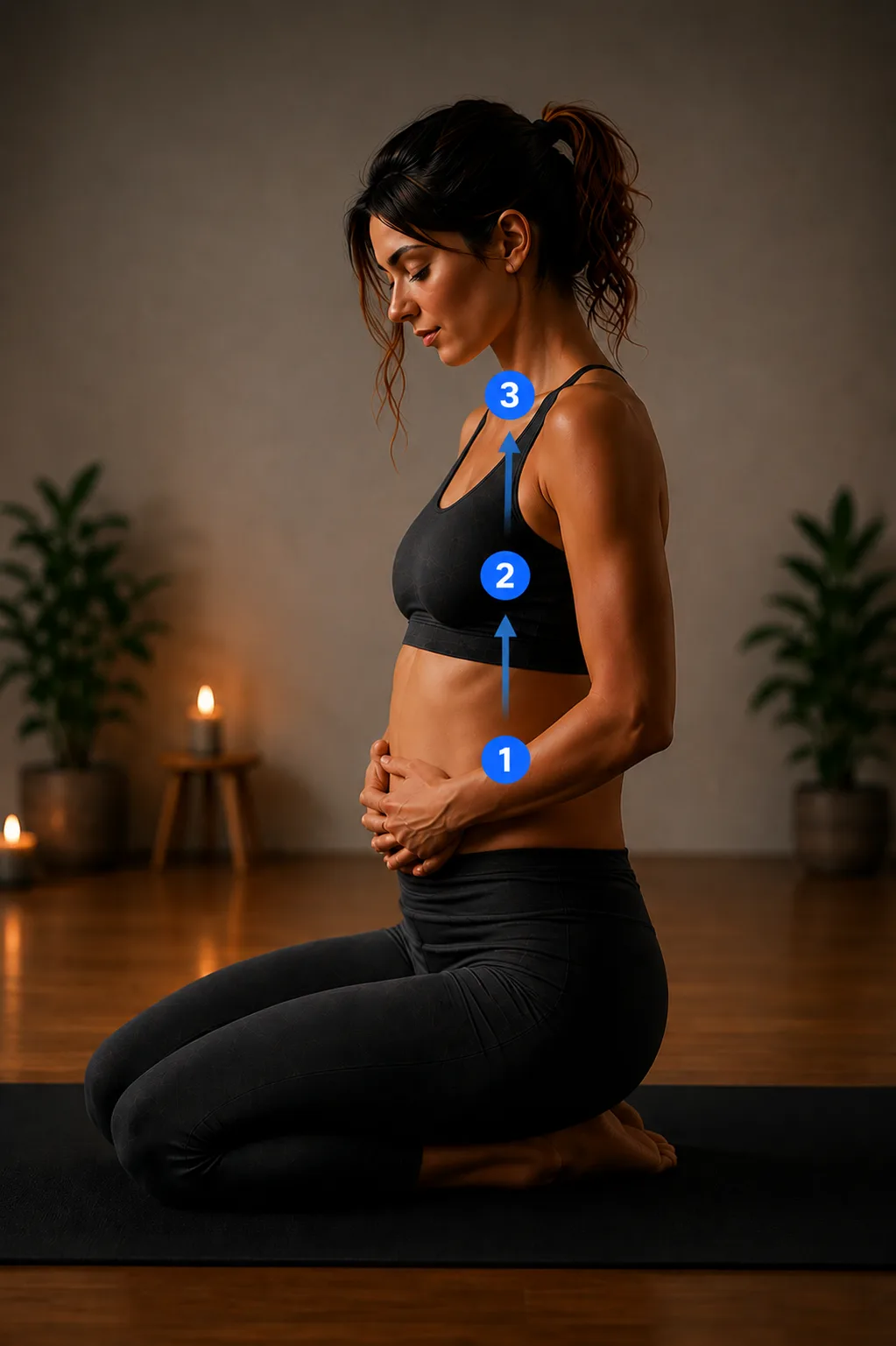
expand the chest
the rib cage rises

head back, tongue on the roof of the mouth
hold for 2-5 sec.
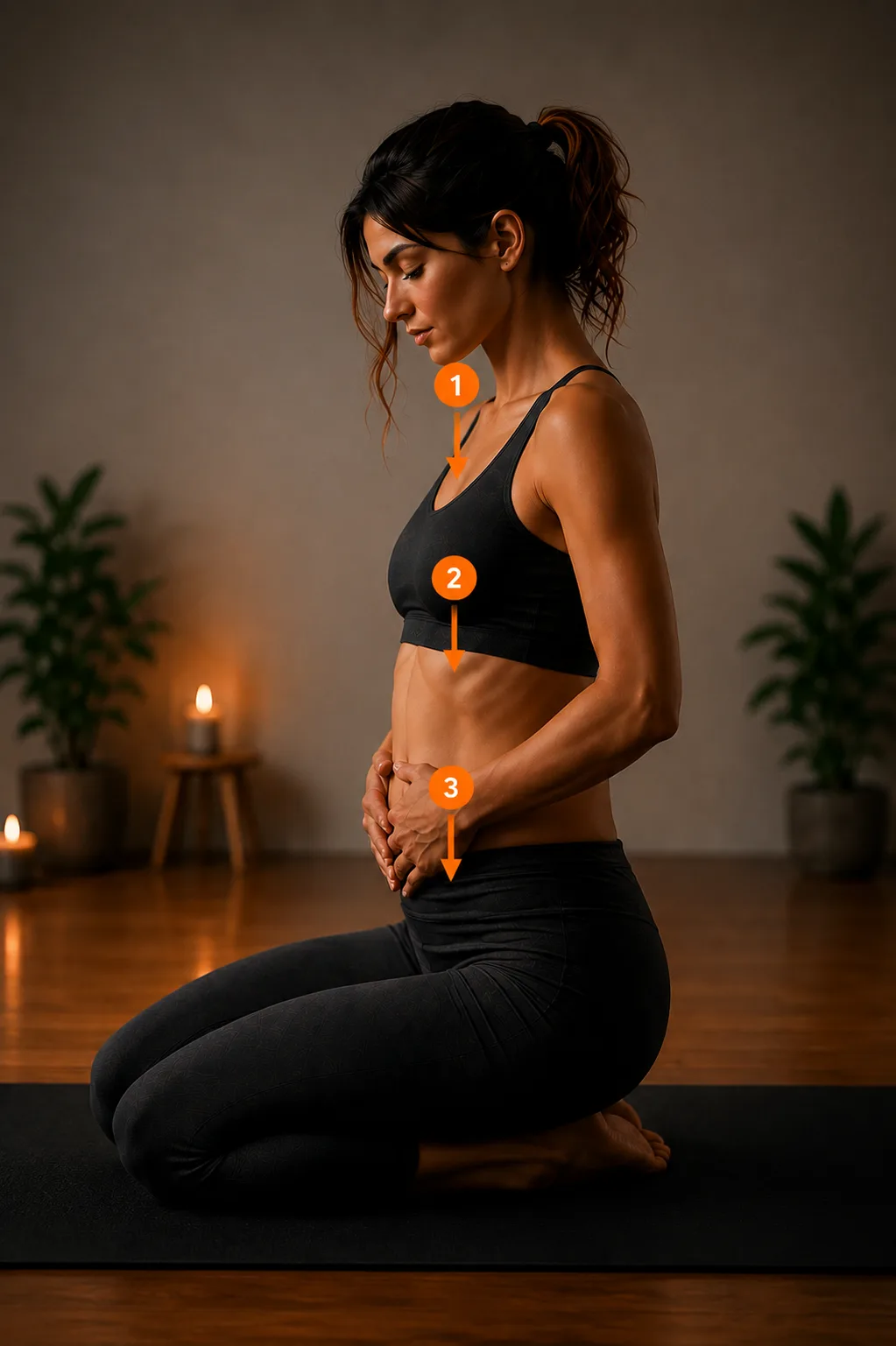
exhale through the mouth
first upper lung, then chest, then belly

release all the air and contract the belly, vaginal/anal sphincter
hold for 2-5 sec.
The 6 steps:
- Inhale through the nose. Prepare to inhale. Relax your shoulders and posture.
- Expand the belly (the abdomen moves outward). First, let the belly expand as the air comes in.
- Expand the chest (the rib cage rises). Next, the chest expands as you continue inhaling.
- Hold for 2 to 5 seconds. With the body fully filled with air, gently tilt the head back and touch the tip of the tongue to the roof of the mouth. This gesture closes the circuit and extends the retention phase without discomfort.
- Exhale slowly through the mouth. The air leaves in order: first the upper lung empties, then the chest, then the belly.
- Release all the air and contract the belly, vaginal and anal sphincter. Empty completely. Hold for 2 to 5 seconds before starting the next inhale.
When the mind wanders, bring your attention back to the breath, without judgment.
Restart the cycle as many times as you need to feel good.
Benefits documented in the clinical literature reviewed above:
- Reduced stress and anxiety (Goyal 2014; Galante 2021)
- Reduced cortisol in populations with chronic stress (Koncz 2021)
- Modest reduction in blood pressure (AHA 2017)
- Improved lung function (slow controlled breathing studies)
- Increased mental clarity and sustained attention
Breathing with a longer exhale than inhale and active engagement of the diaphragm is what activates the parasympathetic system, the biochemical gateway to everything else.
Body scan (10 to 15 minutes)
A body-scanning practice, with documented effects on chronic tension and pain.
How to do it:
- Lie down or sit comfortably.
- Start by bringing attention to your feet. Notice temperature, weight, tension, contact with the floor.
- Move up slowly: calves, knees, thighs, hips, abdomen, chest, shoulders, arms, hands, neck, face, top of the head.
- In each area, observe without changing anything. If there’s tension, simply acknowledge it.
- Finish by returning to the breath and open your eyes slowly.
App-guided mindfulness (10 to 20 minutes)
For those who prefer a voice and external structure. Apps with evidence of clinical use: Insight Timer (free), Calm, Headspace, Lojong. Look for short practices at first and stick with the same guide for a few weeks before switching.
Sustaining the practice
- A fixed time - morning upon waking and late afternoon are the most regular. Consistent timing anchors the habit.
- A fixed place - the same corner of the house, the same chair. The brain associates context with the practice.
- Start short - 5 minutes for 30 days before increasing.
- Don’t judge the wandering mind - wandering is part of the process. What matters is noticing and returning.
Who benefits
- Adults with chronic stress, overload, sustained hyper-responsibility.
- Mild to moderate anxiety, panic attacks and depression.
- Metabolic syndrome, insulin resistance, visceral adiposity.
- Prediabetes and type 2 diabetes as an adjunct (the reduction in cortisol contributes to glycemic control).
- Mild to moderate hypertension as an adjunct, added to antihypertensive treatment when indicated.
- Chronic musculoskeletal and neuropathic pain (the literature includes fibromyalgia, irritable bowel syndrome, and post-breast-cancer pain).
- Insomnia and fragmented sleep.
- Asthma and respiratory conditions with a stress component.
- Women in the menopausal transition, where HPA axis regulation has a direct impact on vasomotor symptoms, sleep, and body composition.
Who should be cautious or avoid it
- Unprocessed trauma or post-traumatic stress disorder (PTSD), internal attention practices can amplify traumatic memories. Prefer an approach guided by a mental health professional, with specific modalities (trauma-sensitive mindfulness).
- Active or transitioning psychosis (first episode, hallucinations), intensive meditation practice isn’t recommended in these cases.
Conclusion
Genetics informs risk, but it doesn’t define destiny. Health is built through the interaction between genetic predisposition, environment, behavior, and sustained choices over a lifetime.
In this context, meditation is a simple, relevant tool for regulating stress, strengthening emotional self-regulation, and favoring a more balanced biological ground. Combined with physical exercise, adequate sleep, healthy eating, good relationships, and clinical follow-up when indicated, it contributes to more health, prevention, and longevity.
Starting can be simple: five to ten minutes a day, at a fixed time, with attention to the breath. Consistency turns the practice into a daily signal of safety for the body, and into a concrete path toward taking the lead in your own health.
Resources for practicing
Music for meditating and relaxing
- Handpan meditation, 1 hour - Malte Marten
- Reiki music for emotional and physical healing
- 1111 Hz healing frequency - handpan 1 hour - Malte Marten & Lynxk
- 639 Hz - Tibetan sounds to clear negative energy
- 417 Hz shamanic music - clearing energy and positive thoughts
- The quiet beauty of everyday life - piano for meditation
- Inner Balance - 432 Hz + 111 Hz for balance and inner peace
- The Sound of Inner Peace 14 - 528 Hz for meditation, yoga and relaxation
Mantras
- Mantra for removing negative energy - strength and vitality
- Gayatri Mantra - Deva Premal & Miten (live)
- Maha Mrityunjaya Mantra (108 times) - Sounds of Isha
- Om Mani Padme Hum - Buddhist mantra for peace and meditation
Guided meditations
References
Scientific studies
Levine et al., 2017.Meditation and Cardiovascular Risk Reduction: A Scientific Statement From the American Heart Association. Journal of the American Heart Association. 2017;6(10):e002218. · Acessar fonte
Key findings
The American Heart Association's official position on meditation and cardiovascular risk. The document systematically reviews the literature on meditation's effects on physiological stress response, smoking cessation, blood pressure reduction, insulin resistance and metabolic syndrome, endothelial function, inducible myocardial ischemia, and primary and secondary prevention of cardiovascular disease. Its tone is cautious and honest: studies suggest possible benefit, but the quality and quantity of data are still modest for several outcomes. Given the practice's low cost-risk ratio, meditation can be considered an adjunct to conventional therapies for those interested in lifestyle modification, without replacing medication when indicated. Additional research with a more robust design is needed for firmer conclusions.
Levine et al., 2021.Psychological Health, Well-Being, and the Mind-Heart-Body Connection: A Scientific Statement From the American Heart Association. Circulation. 2021;143(10):e763-e783. · Acessar fonte
Key findings
An AHA scientific statement on the connection between psychological health and cardiovascular disease. It brings concrete numbers on the clinical weight of stress: high perceived stress is associated with a 27% higher risk of coronary heart disease and cardiovascular death; depression with a 30% higher risk of heart attack and 45% higher risk of stroke; social isolation and loneliness with a 50% higher risk of cardiovascular events. It acknowledges that psychological health can be causally linked to biological processes and behaviors that contribute to cardiovascular disease, and that interventions to improve psychological health, including mindfulness and meditation, have a documented beneficial impact on cardiac outcomes. It recommends incorporating psychological health screening into routine cardiology practice.
Goyal et al., 2014.Meditation Programs for Psychological Stress and Well-being: A Systematic Review and Meta-analysis. JAMA Internal Medicine. 2014;174(3):357-368. · Acessar fonte
Key findings
A systematic review and meta-analysis of 47 randomized clinical trials and 3,515 participants on meditation programs for psychological stress. Mindfulness showed moderate-magnitude evidence for reducing anxiety (effect 0.38), depression (0.30) and pain (0.33). For sleep, weight, attention, eating habits, substance use and positive mood, the evidence was insufficient or inconclusive. The authors explicitly note that they found no evidence that meditation is superior to active treatments like medication, exercise, or other behavioral therapies. An honest position: meditation is a useful clinical tool, with a favorable safety profile, integrated into the broader set of lifestyle interventions.
Galante et al., 2021.Mindfulness-based programmes for mental health promotion in adults in nonclinical settings: A systematic review and meta-analysis of randomised controlled trials. PLOS Medicine. 2021;18(1):e1003481. · Acessar fonte
Key findings
A comprehensive meta-analysis in PLOS Medicine with 136 randomized clinical trials and 11,605 participants in 29 countries, on mindfulness-based programs in nonclinical adults. Compared with no intervention, mindfulness reduced anxiety (SMD -0.56), depression (-0.53), psychological distress (-0.45) and increased well-being (+0.33), all statistically significant. The authors bring important nuance: heterogeneity between studies is high, the effect doesn't automatically generalize to any community context, and mindfulness wasn't superior to other active practices like physical exercise. A balanced conclusion: mindfulness works, and other lifestyle practices with a similar goal also work. The choice can be personalized according to affinity and context.
Koncz et al., 2021.Meditation interventions efficiently reduce cortisol levels of at-risk samples: a meta-analysis. Health Psychology Review. 2021;15(1):56-84. · Acessar fonte
Key findings
A meta-analysis dedicated to meditation's effect on cortisol across different populations. In samples with elevated cortisol due to somatic disease (cancer, cardiovascular disease, type 2 diabetes, polycystic ovary syndrome), mental disorders (depression, post-traumatic stress disorder), or stressful situations (caregivers, low socioeconomic status, smoking cessation), meditation reduced blood cortisol with a medium effect (g=0.62, 10 trials). In healthy samples without a marked stressor, the effect was small and not significant. The hypothesis was confirmed: meditation buffers stress more for those who need it most. Two practical findings: programs with more than 20 total hours were more effective, and the benefit is sustained over time, it doesn't decay.
Buric et al., 2017.What Is the Molecular Signature of Mind-Body Interventions? A Systematic Review of Gene Expression Changes Induced by Meditation and Related Practices. Frontiers in Immunology. 2017;8:670. · Acessar fonte
Key findings
A systematic review of 18 studies on gene expression changes induced by meditation, yoga, tai chi and conscious breathing. The consistent pattern across practices is reduced expression of pro-inflammatory NF-kB pathway genes (RIPK2, COX2, IL-6) and increased expression of anti-inflammatory pathways. The authors define this as the conserved molecular signature of mind-body interventions, and discuss the biological pathway: reduced sympathetic tone, reduced cortisol and norepinephrine release, and downregulation of the pro-inflammatory program associated with chronic stress (CTRA, conserved transcriptional response to adversity).
Mayo Clinic Staff, 2026.Mindfulness exercises. Mayo Clinic - patient education. Updated January 21, 2026. · Acessar fonte
Key findings
Institutional material from Mayo Clinic aimed at patients and professionals, with periodic clinical review. It defines mindfulness as the state of being attentive and aware of the present moment, without judgment, and dispels three common myths that get in the way of starting: you don't need to empty your mind, you don't need to sit cross-legged for long periods, and it doesn't require much time, even 10 minutes a day produces a measurable benefit. It describes practical exercises (conscious breathing, body scan, walking meditation, mindful attention during everyday activities) and organizes the benefits documented in research: reduced cortisol and stress response, improved anxiety, depression, sleep and chronic pain, and an impact on hypertension, glycemic control in diabetes, and asthma symptoms. It reinforces that regular practice for about six months tends to turn meditation into a sustained habit.
CDC, 2025.Epigenetics and Health. Centers for Disease Control and Prevention - National Center on Birth Defects and Developmental Disabilities. Updated January 31, 2025. · Acessar fonte
Key findings
Official, up-to-date CDC material, with 11 peer-reviewed citations, on epigenetics and health. It defines epigenetics as the set of mechanisms through which behavior and environment modify how genes function (mainly DNA methylation), without changing the genetic sequence. It presents established examples: prenatal nutrition (the Dutch Hunger Winter), smoking (a documented, reversible effect with cessation), cellular development, aging, and cancer (BRCA1 and colorectal cancer). It's the clearest institutional reference for supporting the article's central thesis: genetic predisposition isn't destiny, and lifestyle modifies biology.
NCI Dictionary of Genetics Terms.Genetic predisposition. NCI Dictionary of Genetics Terms. National Cancer Institute - National Institutes of Health. · Acessar fonte
Key findings
The National Cancer Institute's (NCI) official definition of genetic predisposition. It's an increased chance of developing a certain disease based on the presence of one or more genetic variants or a family history suggestive of risk. The central point of the definition: having a genetic predisposition doesn't mean the individual will develop the disease, environmental and lifestyle factors also affect risk. Recognized synonyms: genetic susceptibility, hereditary predisposition, and inherited predisposition. It's the institutional basis for the argument that biology responds to behavior, exactly the ground on which meditation operates.
Balban et al., 2023.Brief structured respiration practices enhance mood and reduce physiological arousal. Cell Reports Medicine. 2023;4(1):100895. · Acessar fonte
Key findings
A Stanford randomized clinical trial (Huberman, Spiegel et al.) with 114 adults comparing three controlled breathing techniques with mindfulness meditation over a month. Main result: 5 daily minutes of breathing with prolonged exhale (cyclic sighing) outperformed meditation in improving mood and reducing respiratory rate. Cyclic sighing was the most effective technique among the three modalities tested. Published in Cell Reports Medicine, part of the Cell Press family.
Fincham et al., 2023.Effect of breathwork on stress and mental health: A meta-analysis of randomised-controlled trials. Scientific Reports. 2023;13:432. · Acessar fonte
Key findings
A meta-analysis of 12 randomized clinical trials with 785 adults on controlled breathing techniques for stress and mental health, published in Scientific Reports (Nature portfolio). Breathwork reduced stress (g=-0.35), anxiety (g=-0.32) and depressive symptoms (g=-0.40). The paper documents that approximately 80% of vagus nerve fibers carry messages from the body to the brain, the anatomical basis for understanding why breathing has such a direct effect on mental and emotional states.
Laborde et al., 2022.Effects of voluntary slow breathing on heart rate and heart rate variability: A systematic review and a meta-analysis. Neuroscience & Biobehavioral Reviews. 2022;138:104711. · Acessar fonte
Key findings
A systematic review and meta-analysis of 223 studies on the effects of voluntary slow breathing on vagally mediated HRV. It documented consistent increases in vmHRV during the session, immediately after, and after multi-session interventions. Slow breathing (~6 cycles/minute) is highlighted as a low-cost technique with preventive and adjunctive potential.
Shao et al., 2024.The Effect of Slow-Paced Breathing on Cardiovascular and Emotion Functions: A Meta-Analysis and Systematic Review. Mindfulness. 2024;15:1-18. · Acessar fonte
Key findings
A meta-analysis and systematic review of 31 studies (n=1,133) on the effects of slow breathing on cardiovascular and emotional function in nonclinical populations. Slow breathing reduced systolic blood pressure (SMD=-0.45), increased RMSSD (SMD=0.37) and SDNN (SMD=0.77), and decreased heart rate. A frequency of ~6 cycles/minute was identified as the optimal point for maximizing HRV and baroreflex gain.
Lopez Blanco & Tyler, 2025.The vagus nerve: a cornerstone for mental health and performance optimization in recreation and elite sports. Frontiers in Psychology. 2025;16:1639866. · Acessar fonte
Key findings
A 2025 review of the vagus nerve's role in mental health and physical and cognitive performance. It details how slow diaphragmatic breathing at 6 cycles/minute maximizes respiratory sinus arrhythmia, the baroreflex, and resting vagal tone. Weeks of practice produce lasting gains. It covers the cholinergic anti-inflammatory pathway and the relationship between HRV and cognitive and emotional resilience. It notes polyvagal theory as a debated framework.
Tracey, 2002.The inflammatory reflex. Nature. 2002;420(6917):853-859. · Acessar fonte
Key findings
A foundational paper published in Nature describing the inflammatory reflex mediated by the vagus nerve, the neural pathway through which the nervous system regulates the inflammatory response in real time. The vagus's efferent branch releases acetylcholine that suppresses pro-inflammatory cytokines (TNF, IL-1, IL-6) from macrophages, called the cholinergic anti-inflammatory pathway. This is the scientific basis for understanding the role of vagal tone as active immune protection.
Informational content. Health recommendations and protocols require individual assessment by qualified professionals.